
After his decision to return back to academia, there have been voices suggesting that his candid public speeches were one of the aspects which made the government uncomfortable about reappointing Rajan for another term

'There are so many dimensions to history that we need to attend to: We need more space for local and regional histories; we need to delve into the histories of particular communities; we need to emphasise gender history and environmental history.' 'We need to think about India's history beyond India's current borders.'

If purists are surprised as to why and how people are not demanding prohibition or not talking about past promises, both in the election manifestos five years back and even those made to the courts, the answer lies in how the state has been evolving and changing these past few years, says N Sathiya Moorthy.
Noting the "widespread cynicism and disillusionment" with governance and functioning of institutions, President Pranab Mukherjee on Wednesday said elections next year is an opportunity to elect a stable government that will ensure security and economic development.

'Rajan's exit will have a great impact on the economy.'

May be the strong United States growth will lead the world back to a period of growth and help us all put this painful recrimination behind us.

Rajan, who has also served as chief economist at the International Monetary Fund (IMF), said he had no idea what statistics are pointing at currently and "a revamp" was needed "to really figure out what India's true growth rate is".

A single party will need at least 137 of the directly elected seats to be able to form the government on its own.

The global ratings agency keeps India's sovereign rating unchanged at 'BBB-' with stable outlook
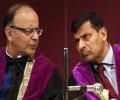
Reserve Bank will hold its first bi-monthly monetary policy review for 2016-17 on Tuesday.

Diplomats agree that amid stormy relations with China and Pakistan, Modi has posted impressive foreign policy successes, notes Aditi Phadnis.

PM stressed that 'response to terrorism must be nothing less than comprehensive'.

Chief Justice of India Justice T S Thakur today said that "corresponding upgradation" of judiciary was a must to face the challenges of emerging social and economic scenario and observed that "unpolluted and speedy justice still remains a distant dream".
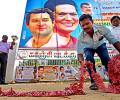
Exit polls often go wrong in India because pollsters don't sample voters in the poorest parts of the country or the core support bases of different political parties, explains Professor Atanu Biswas of the Indian Statistical Institute, Kolkata.
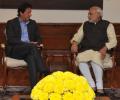
Should India engage Pakistan's generals directly, bypassing Imran? Ambassador G Parthasarathy, India's former high commissioner to Pakistan, ponders Delhi's diplomatic dilemma.
'We have promised to ensure reduced tax rates.'
'According national security and higher defence management empathetic political attention they warrant is critical. Will Prime Minister Modi pick up this gauntlet?' asks C Uday Bhaskar.
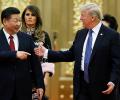
'We have here the world's largest economy and dominant superpower thrashing about as it wrestles with its own decline.' 'It has become everything that China was supposed to be: A threat to the world order, and as a country that is not playing by the rules on trade, on climate change, international commitments and nuclear deals,' says T N Ninan.

'Modi's decision to hold out an olive branch to Sharif within 48 hours of the 'surgical strikes' has been a timely move as it helps tensions to 'de-escalate',' says Ambassador M K Bhadrakumar.
The State is trying to curb the students movements, therefore, there are suspicions against some of the Subramanian report on education's recommendations, says Mohammad Sajjad.

Here's the full text of President Ram Nath Kovind's address to the nation on the eve of 71st Republic Day.

Recent IMF forecast said China's growth is expected to slow down.

No country has achieved a faster, deeper modern transformation than China, says former ambassador Kishan S Rana.
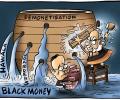
'Modi is likely to make more announcements to win or retain popularity, and put himself at the centre of things even more than now,' says T N Ninan.
The Modi PMO is like none other: It is staffed by people who are so low profile that the only dominant personality is the Prime Minister's.
'The UPA was the gang that couldn't shoot straight. The NDA is the gang that can't stop shooting. They (the Modi government) are shooting at anybody, everybody, all directions, shooting themselves in the foot.'
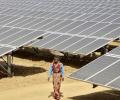
Arunabha Ghosh on why India will increasingly become an energy great power, but not an energy hegemon.

PM Modi must revive investment sentiment in the country.
.jpg)
The eternal question remains unanswered, what price security and what cost liberty, says Vikram Sood.

He said RSS men were planted in each ministry.

Gandhi has been attacking the BJP government for allegedly inking the deal at a much higher price than the one the previous United Progressive Alliance regime had negotiated to benefit 'one businessman'.

The markets gained nearly 7 per cent in the 4 trading sessions of March.

'Over the last two decades, the India-French relationship has grown steadily, no major political difference having darkened the sky between Paris and Delhi,' says Claude Arpi.
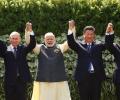
Narendra Modi's success at the BRICS summit is the best Diwali gift for India's diplomacy and marks her ascendancy to global leadership, says Tarun Vijay.

China, France and Spain are emerging as hotspots for Indian students.

'The prime minister did not think that COVID-19 was a serious challenge as late as March 20.'

Former Watson Fellow and social entrepreneur Srikar Gullapalli talks about the issues affecting India's growth and tells us why he wants more people to actively participate in building a bright future and put India on the global map.

'Ensuring through diplomatic means and in conjunction with strategic partners that India will not be required to fight a simultaneous two-front war with China and Pakistan.' Brigadier Gurmeet Kanwal (retd) lists what India must have in its national security strategy.
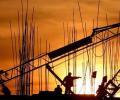
Whilst substantive public allocations have been made in the infrastructure sector, this strategy is plateauing due to the fiscal deficit constraint, capacity limitation of statal implementing agencies, the declining ability of PSUs, and the precarious situation of the Railways' operating ratio. It is, thus, high time to get the policy compass to point at rejuvenating private sector investments in infrastructure, says Vinayak Chatterjee.

'Since Modi is walking a tightrope between two worlds -- one of the saffron brotherhood and the other of the proposed smart cities and bullet trains -- it is understandable why he is averse to scrutiny lest he loses his balance by tilting too heavily on one side or the other. But, why has Sonia Gandhi acquired the reputation of a sphinx,' asks Amulya Ganguli.
